How much is too much when it comes to wealth? Even though most of us have more than what we need to sustain a basic lifestyle, we are typically clamoring for better than what we have right now. It's unthinkable that we would pray to God to limit his blessing to us but it's exactly what we discover in Proverbs 30:7-9. Two things are asked for. The first is the protection from falsehoods but it's the second part of the request that I find most intriguing - "give me neither poverty or riches".
“Two things I ask of you, LORD;
do not refuse me before I die:
Keep falsehood and lies far from me;
give me neither poverty nor riches,
but give me only my daily bread.
Otherwise, I may have too much and disown you
and say, ‘Who is the LORD?’
Or I may become poor and steal,
and so dishonor the name of my God"
This is presented to us as the prayer of a wise man, yet I would venture that most (if not all) of us have never even considered praying such a prayer - "give me neither poverty or riches, but give me only my daily bread". We would never consider to ask God to only give us what we need for today and no more - no "rainy day" fund, no nest egg for retirement, no set-aside for dream vacation, etc... Popular preacher Francis Chan elaborates on Proverbs 30:7-9 in this short, provocative video.
Is this a blueprint for how we ought to pray and live? How does this mesh with the conventional wisdom of saving and planning? Would you have the courage to pray this prayer and how would you respond if God actually answered?
It's easy to get lost in the myriad of questions that arise but don't lose sight of the God-centered motivation of this prayer request. It's all about God - not having too little so as to avoid the temptations that come with being impoverished - yet, not having too much such that God is no longer desired and possibly forgotten. This passage is about treasuring God and the worth of His name and not letting anything get in its way. Perhaps that's the kind of motivation we might be wise to incorporate into our prayers.
Showing posts with label prosperity. Show all posts
Showing posts with label prosperity. Show all posts
Saturday, January 15, 2011


Monday, August 16, 2010
Why Boasting in Your Humiliation is Good for Your Soul
"Let the lowly brother boast in his exaltation, and the rich in his humiliation..."
I've been pondering the seeming irony of this verse for the past couple of months. To the lowly, James instructs to boast in their exaltation but the rich are told to focus on their humiliation. It's counter-intuitive to way this world works but it's the way the invisible, other-worldly kingdom of Christ.
Many of us will, at times, find ourselves either as lowly or rich, depending on the circumstance. The focus of my meditation however, has been on what it means for the rich Christian, to "boast in his humiliation". The idea of humiliation in this context is stark and extreme. Boasting or making much of our humiliation does not come naturally to any of us, even less so for those who are rich or powerful. Yet, it's exactly the prescription James offers for those who are rich in the assembly of the church.
More importantly, how does one boast in his humiliation. Here are four ways that you may find helpful if on occasion and circumstance, you find yourself counted among the rich.
1. Consider our own mortality and finitude -
Reading James 1:10-11 in entirety sheds light on this -
"Let the lowly brother boast in his exaltation and the rich in his humiliation because like a flower of the grass he will pass away. For the sun rises with its scorching heat and withers the grass; its flower falls, and its beauty perishes. So will the rich man fade away in the midst of his pursuits"
The rich person ought to boast in his humiliation because he will pass away - his wealth, fame and power will not last. Boasting in your humiliation means reminding yourself and anyone around you) that your wealth and power is finite and will pass with time. It also means that you want live to as to demonstrate that this is true.
2. Live to pursue God, not wealth, power or fame
The admonition assumes that the rich man is pursuing wealth as the aim of his life. But boasting in our humiliation means demonstrating the folly of this approach. The wise rich believer who chooses to do this, will pursue God instead of wealth or self-aggrandizement of any kind.
3. Make plans with deference to God's will
James 4: 13-16 speaks to the mindset that undergirds this kind of plan-making. It is the kind of plan making that not only seeks to discover God's will but also depends on God's power to accomplish the objectives of the plan.
Come now, you who say, "Today or tomorrow we will go into such and such a town and spend a year there and trade and make a profit"- yet you do not know what tomorrow will bring. What is your life? For you are a mist that appears for a little time and then vanishes. Instead you ought to say, "If the Lord wills, we will live and do this or that." As it is, you boast in your arrogance. All such boasting is evil.
The temptation for some of us is to invest trust not in God but in our ability to execute well-crafted plans. When you're in a position of relative wealth or power, you might not be aware of your daily need for God's provision. God calls such presumption - evil boasting. Rather, we ought to make our plans with deference to God's will and with an awareness of our need for His blessing.
4. Remember your true identity.
Boasting in our humiliation means keeping in mind our true identity as sinners saved by the grace and generosity of God. While there isn't a particular verse in James that clearly illustrates this, it is unquestionable that James himself understood this. He chose to address himself as "...servant of God and of the Lord Jesus Christ" even though he was, humanly speaking, the brother of Jesus. In the words of Paul, James chose to count his familial relationship "as loss" for the sake of knowing Christ Jesus. Whether rich or poor, we were spiritual orphans, adopted into God's family and now we enjoy full privileges only as a result of God's kindness.
I've been pondering the seeming irony of this verse for the past couple of months. To the lowly, James instructs to boast in their exaltation but the rich are told to focus on their humiliation. It's counter-intuitive to way this world works but it's the way the invisible, other-worldly kingdom of Christ.
Many of us will, at times, find ourselves either as lowly or rich, depending on the circumstance. The focus of my meditation however, has been on what it means for the rich Christian, to "boast in his humiliation". The idea of humiliation in this context is stark and extreme. Boasting or making much of our humiliation does not come naturally to any of us, even less so for those who are rich or powerful. Yet, it's exactly the prescription James offers for those who are rich in the assembly of the church.
More importantly, how does one boast in his humiliation. Here are four ways that you may find helpful if on occasion and circumstance, you find yourself counted among the rich.
1. Consider our own mortality and finitude -
Reading James 1:10-11 in entirety sheds light on this -
"Let the lowly brother boast in his exaltation and the rich in his humiliation because like a flower of the grass he will pass away. For the sun rises with its scorching heat and withers the grass; its flower falls, and its beauty perishes. So will the rich man fade away in the midst of his pursuits"
The rich person ought to boast in his humiliation because he will pass away - his wealth, fame and power will not last. Boasting in your humiliation means reminding yourself and anyone around you) that your wealth and power is finite and will pass with time. It also means that you want live to as to demonstrate that this is true.
2. Live to pursue God, not wealth, power or fame
The admonition assumes that the rich man is pursuing wealth as the aim of his life. But boasting in our humiliation means demonstrating the folly of this approach. The wise rich believer who chooses to do this, will pursue God instead of wealth or self-aggrandizement of any kind.
3. Make plans with deference to God's will
James 4: 13-16 speaks to the mindset that undergirds this kind of plan-making. It is the kind of plan making that not only seeks to discover God's will but also depends on God's power to accomplish the objectives of the plan.
Come now, you who say, "Today or tomorrow we will go into such and such a town and spend a year there and trade and make a profit"- yet you do not know what tomorrow will bring. What is your life? For you are a mist that appears for a little time and then vanishes. Instead you ought to say, "If the Lord wills, we will live and do this or that." As it is, you boast in your arrogance. All such boasting is evil.
The temptation for some of us is to invest trust not in God but in our ability to execute well-crafted plans. When you're in a position of relative wealth or power, you might not be aware of your daily need for God's provision. God calls such presumption - evil boasting. Rather, we ought to make our plans with deference to God's will and with an awareness of our need for His blessing.
4. Remember your true identity.
Boasting in our humiliation means keeping in mind our true identity as sinners saved by the grace and generosity of God. While there isn't a particular verse in James that clearly illustrates this, it is unquestionable that James himself understood this. He chose to address himself as "...servant of God and of the Lord Jesus Christ" even though he was, humanly speaking, the brother of Jesus. In the words of Paul, James chose to count his familial relationship "as loss" for the sake of knowing Christ Jesus. Whether rich or poor, we were spiritual orphans, adopted into God's family and now we enjoy full privileges only as a result of God's kindness.
Thursday, February 18, 2010
We Are Slaves Of What We Crave
You've probably heard about how "money can't buy happiness" but seldom from folks as wealthy as Austrian millionaire, Karl Rabeder. Mr Rabeder came to this realization and proceeded to put together a plan to give his $4.7M fortune away... all of it.
"My idea is to have nothing left. Absolutely nothing."
Like many, Mr Rabeder used to pursue material wealth as a means to a happier life -
"For a long time I believed that more wealth and luxury automatically meant more happiness,"
Even though he knew better, over the years he never had the courage to give up the trappings of the "good life". However, over time, he came to a new and counter-cultural conclusion - he was enslaved by his possessions.
"I had the feeling I was working as a slave for things that I did not wish for or need...there are lot of people doing the same thing."
His conclusion upholds an unequivocal principle - "we are slaves to the things we crave".
We don't actually have to possess things to be enslaved by them... we only have to want or crave things for them to have a hold on our lives.
Jesus' words from Luke 12:15 serve as a sobering reminder for us -
"Take care, and be on your guard against all covetousness, for one’s life does not consist in the abundance of his possessions."
It's not simply possessions that we are to guard against but rather against "all covetousness". We can be poor and yet covet. Unguarded, we could find ourselves placing our hopes of a better life in the riches and possessions of this world. The problem with coveting is that the treasure we pursue is not worthy of the purpose for which we were made. On the contrary, if we desire fellowship with God, we will find ourselves joyfully and satisfyingly captive to Him.
If like Mr Rabeder, we find that "we are slaves of what we want", then perhaps it would be appropriate to ask - "what is it that you really want and is it ultimately satisfying to your soul?"
"My idea is to have nothing left. Absolutely nothing."
Like many, Mr Rabeder used to pursue material wealth as a means to a happier life -
"For a long time I believed that more wealth and luxury automatically meant more happiness,"
Even though he knew better, over the years he never had the courage to give up the trappings of the "good life". However, over time, he came to a new and counter-cultural conclusion - he was enslaved by his possessions.
"I had the feeling I was working as a slave for things that I did not wish for or need...there are lot of people doing the same thing."
His conclusion upholds an unequivocal principle - "we are slaves to the things we crave".
We don't actually have to possess things to be enslaved by them... we only have to want or crave things for them to have a hold on our lives.
Jesus' words from Luke 12:15 serve as a sobering reminder for us -
"Take care, and be on your guard against all covetousness, for one’s life does not consist in the abundance of his possessions."
It's not simply possessions that we are to guard against but rather against "all covetousness". We can be poor and yet covet. Unguarded, we could find ourselves placing our hopes of a better life in the riches and possessions of this world. The problem with coveting is that the treasure we pursue is not worthy of the purpose for which we were made. On the contrary, if we desire fellowship with God, we will find ourselves joyfully and satisfyingly captive to Him.
If like Mr Rabeder, we find that "we are slaves of what we want", then perhaps it would be appropriate to ask - "what is it that you really want and is it ultimately satisfying to your soul?"
Saturday, March 21, 2009
Is Ambition Wrong?
This morning I had the opportunity to lead a discussion on the topic of ambition with a group of friends from my church. The dynamics of ambition in the workplace can be a thorny issue for many Christians. It raises some challenging questions like - "is ambition wrong?" or "what does godly ambition look like, especially if you're not a pastor or minister?"
I'd like to share and extend the discussion on this blog post by addressing the first question - "is ambition wrong?" Ambition is often defined as "an earnest desire for achievement or distinction...and a willingness to work for its attainment". Many would equate that achievement to wealth, fame or power but does it really have to be so? For Christians, the seeds of ambition are often the dreams, desires and goals that God places in our lives. Seen from that perspective, ambition isn't just "not wrong" - it's normal.
However, the Bible does warn us about certain kinds of ambition that are unfruitful or even sinful. Two kinds of wrong ambition come immediately to mind -
1. Selfish ambition - where we measure opportunities (think: career , ministry, etc...), primarily in terms of "what's in it for me". James 3:16 warns us of negative consequences when selfish ambition is played out in real life.
"For where jealousy and selfish ambition exist, there will be disorder and every vile practice."
2. The pursuit of wealth - where we measure opportunities, primarily in terms of material gain. The reality is that many of us might not even consider the "desire to be rich" a problem to grapple with. Yet scripture couldn't be more plain in 1 Timothy 6:6-10.
"Now there is great gain in godliness with contentment, for we brought nothing into the world, and we cannot take anything out of the world. But if we have food and clothing, with these we will be content. But those who desire to be rich fall into temptation, into a snare, into many senseless and harmful desires that plunge people into ruin and destruction. For the love of money is a root of all kinds of evils. It is through this craving that some have wandered away from the faith and pierced themselves with many pangs."
Here's the main point of this post -
"Ambition isn't wrong but there is such a thing as wrong ambition and scripture warns us to be on our guard against it"
In the next post, I'll share our discussion about what godly ambition looks like
Have you wrestled with ambition in your life?
Have you identified the presence of selfish ambition?
What does the pursuit of wealth say to the world around us about the value of Jesus Christ?
Please share your thoughts on this
I'd like to share and extend the discussion on this blog post by addressing the first question - "is ambition wrong?" Ambition is often defined as "an earnest desire for achievement or distinction...and a willingness to work for its attainment". Many would equate that achievement to wealth, fame or power but does it really have to be so? For Christians, the seeds of ambition are often the dreams, desires and goals that God places in our lives. Seen from that perspective, ambition isn't just "not wrong" - it's normal.
However, the Bible does warn us about certain kinds of ambition that are unfruitful or even sinful. Two kinds of wrong ambition come immediately to mind -
1. Selfish ambition - where we measure opportunities (think: career , ministry, etc...), primarily in terms of "what's in it for me". James 3:16 warns us of negative consequences when selfish ambition is played out in real life.
"For where jealousy and selfish ambition exist, there will be disorder and every vile practice."
2. The pursuit of wealth - where we measure opportunities, primarily in terms of material gain. The reality is that many of us might not even consider the "desire to be rich" a problem to grapple with. Yet scripture couldn't be more plain in 1 Timothy 6:6-10.
"Now there is great gain in godliness with contentment, for we brought nothing into the world, and we cannot take anything out of the world. But if we have food and clothing, with these we will be content. But those who desire to be rich fall into temptation, into a snare, into many senseless and harmful desires that plunge people into ruin and destruction. For the love of money is a root of all kinds of evils. It is through this craving that some have wandered away from the faith and pierced themselves with many pangs."
Here's the main point of this post -
"Ambition isn't wrong but there is such a thing as wrong ambition and scripture warns us to be on our guard against it"
In the next post, I'll share our discussion about what godly ambition looks like
Have you wrestled with ambition in your life?
Have you identified the presence of selfish ambition?
What does the pursuit of wealth say to the world around us about the value of Jesus Christ?
Please share your thoughts on this
Wednesday, July 23, 2008
Bigger Isn't Always Better

Last week, our family listened a wonderful message by John Piper called "Four Mistakes I Hope You Don't Make". It was addressed to the graduating class of a program for college age students but I think the points he makes are applicable to all of us. The gist of his message revolved around four mistaken assumptions that Christians can make as we navigate our way through life.
The first mistake he highlights is the assumption that big is better than small. It struck me how easily we're preconditioned to this mistake since we live in an age of mass consumerism and discretionary wealth. Let's face it - we are attracted to large and flashy, not small and modest. According to the National Association of Homebuilders, the average size of a home has increased from 1400 square feet in 1970 to 2330 square feet in 2004. As consumers we're demanding bigger portions and the food industry is only too willing to comply - in 1998, the large soda at Burger King was 32 oz...by 2002, it was "supersized" to a 42 oz drink. Bigger portions must be better, right?
Yet this isn't just a modern (or post-modern) malady. It is actually the folly of our fallen condition to assume that "big" is necessarily better than "small". Jesus told a parable to illustrate the folly of covetousness and ever seeking "bigger barns":
And he told them a parable, saying,
(Luke 12:18-21)
Not into building bigger barns? Don't be too sure that this doesn't apply to you.
This shows up in our lives in many different ways. Sometimes, we fail to recognize God's purposes in small beginnings and modest achievements. Perhaps we're in a perpetual search for a better, higher paying, more fulfilling job. Or maybe we're silently dissatisfied that our big dreams aren't being fulfilled. The truth is we're often easily discontented with what we have or where we are, presently.
But God has a different perspective, doesn't He? By His measure, bigger isn't always better. He chose David, a smallish, young shepherd boy in preference to his older, bigger brothers. He is the God of the mustard seed that grows to the largest of trees. God may start us in modest surroundings but He has glorious plans for His elect.
Do you naturally assume that big is necessarily better than small? How have you been tempted to make that mistaken assumption? What encouragement from scripture or elsewhere can help us regain a right focus?
Saturday, December 01, 2007
Elite Evangelicals?
The November issue of Christianity Today had an interesting interview with Michael Lindsay, sociology professor at Rice University. Michael Lindsay is the author of Faith in the Halls of Power, a book about evangelicals joining the ranks of the elite and influential in American society. It is based on 360 interviews conducted with evangelical leaders in various spheres of influence. In the interview, Dr. Lindsay refers to these elite Christians as "cosmopolitan evangelicals" -
"The cosmopolitan evangelicals I write about are people who are just as committed to their faith, just as involved in mainstream evangelical life. By and large, they are very orthodox in their beliefs. Yet they rub shoulders with a much more diverse population... The majority of their working day is spent with people of different faiths or of no faith. They have reached higher levels of education... It's a very elite group,....They read Christianity Today, but they also read The New York Times. They might go to a Christian rock concert, but they also go to the symphony..."
Lindsay shares more of what he's discovered about these elite Christians and how they differ from the rest, the "populist" evangelical community -
"I would say one of the key differences is that populist evangelicals are very interested in converting the other. That's a real driving mechanism—trying to persuade others that Christianity is right. I didn't find that quite as prominent among cosmopolitan evangelicals. They were more interested in legitimacy. They wanted their faith to be seen as valid, something that smart, intelligent people could embrace, that you didn't have to check your brain at the door to accept. You've got this more intelligent, savvy, well-traveled experience that naturally shapes the cosmopolitan's faith."
Apparently, the elite evangelicals also live the best of the American dream -
A lot of the elites I interviewed are really not that different from their peers. They stay in fancy hotels, they drive nice cars; some of them own their own airplanes. They are high flyers, and they aren't necessarily living like the poor.
Yet, according to Lindsay, they don't identify with the local church -
"For many of these leaders, local church involvement is not the principal source of spiritual solidarity. Rather, it comes from being involved in small groups, often among peers. Business leaders meet with other business leaders for a prayer breakfast or a Bible study the first Tuesday of every month. Or folks in the White House get together for the White House Christian fellowship."
I know, it's hard to read this without judging our fellow evangelicals who have found a place among the elite of this world. We must resist succumbing to uncharitable judgments. Generalizations like these can be unfair - I am certain that you know many influential men and women in politics, business and academia who share a deep love and passion for God.
Yet, when I read the interview, I found little to celebrate. Influence is for naught if it magnifies our accomplishments and not the Savior. We misconstrue progress when evangelicals are more interested with their faith being "seen as valid... that smart, intelligent people could embrace" rather than proclaiming the gospel.
Their noted disengagement from local church life isn't just a benign matter of preference, it's a sign of dangerous pride. God has designed church life in order that we might serve and be served by each other, regardless of our social standing, wealth or education. It's the antidote to pride.
Here's why this article caught my attention - the sense of elite evangelicals "having arrived" in American culture is antithetical to what I read this morning in the James 1:9-11.
Let the lowly brother boast in his exaltation, and the rich in his humiliation, because like a flower of the grass he will pass away. For the sun rises with its scorching heat and withers the grass; its flower falls, and its beauty perishes. So also will the rich man fade away in the midst of his pursuits.
You may not consider yourself as one of the evangelical elites, but this verse is instructive to us all. (By the way, as you're reading this blog, if you have food for the week, drive a car, take vacations and have access to healthcare, you are likely among the richest 10% of this world's population.)
James tells us that if you're lowly, you should "boast in [your] exaltation". You should rejoice at the fact that you are actually rich because you possess eternal life. You're a dead man, who has been made alive; a beggar, lavished with the riches of heaven.
However, if you're rich and influential in any way, James says that you should boast in your humiliation. You should take special care to remind yourself that all your wealth will pass away, your natural gifts will fade and your greatest earthly hopes will fail you. This verse meant to remind us that Christ is our only refuge in the day of judgment, our only treasure and the source of everlasting joy. I read these verses in James, both as gentle warning and great encouragement.
Boast in your humiliation. What a different way to think about wealth, influence and the American dream. How otherworldly.
"The cosmopolitan evangelicals I write about are people who are just as committed to their faith, just as involved in mainstream evangelical life. By and large, they are very orthodox in their beliefs. Yet they rub shoulders with a much more diverse population... The majority of their working day is spent with people of different faiths or of no faith. They have reached higher levels of education... It's a very elite group,....They read Christianity Today, but they also read The New York Times. They might go to a Christian rock concert, but they also go to the symphony..."
Lindsay shares more of what he's discovered about these elite Christians and how they differ from the rest, the "populist" evangelical community -
"I would say one of the key differences is that populist evangelicals are very interested in converting the other. That's a real driving mechanism—trying to persuade others that Christianity is right. I didn't find that quite as prominent among cosmopolitan evangelicals. They were more interested in legitimacy. They wanted their faith to be seen as valid, something that smart, intelligent people could embrace, that you didn't have to check your brain at the door to accept. You've got this more intelligent, savvy, well-traveled experience that naturally shapes the cosmopolitan's faith."
Apparently, the elite evangelicals also live the best of the American dream -
A lot of the elites I interviewed are really not that different from their peers. They stay in fancy hotels, they drive nice cars; some of them own their own airplanes. They are high flyers, and they aren't necessarily living like the poor.
Yet, according to Lindsay, they don't identify with the local church -
"For many of these leaders, local church involvement is not the principal source of spiritual solidarity. Rather, it comes from being involved in small groups, often among peers. Business leaders meet with other business leaders for a prayer breakfast or a Bible study the first Tuesday of every month. Or folks in the White House get together for the White House Christian fellowship."
I know, it's hard to read this without judging our fellow evangelicals who have found a place among the elite of this world. We must resist succumbing to uncharitable judgments. Generalizations like these can be unfair - I am certain that you know many influential men and women in politics, business and academia who share a deep love and passion for God.
Yet, when I read the interview, I found little to celebrate. Influence is for naught if it magnifies our accomplishments and not the Savior. We misconstrue progress when evangelicals are more interested with their faith being "seen as valid... that smart, intelligent people could embrace" rather than proclaiming the gospel.
Their noted disengagement from local church life isn't just a benign matter of preference, it's a sign of dangerous pride. God has designed church life in order that we might serve and be served by each other, regardless of our social standing, wealth or education. It's the antidote to pride.
Here's why this article caught my attention - the sense of elite evangelicals "having arrived" in American culture is antithetical to what I read this morning in the James 1:9-11.
Let the lowly brother boast in his exaltation, and the rich in his humiliation, because like a flower of the grass he will pass away. For the sun rises with its scorching heat and withers the grass; its flower falls, and its beauty perishes. So also will the rich man fade away in the midst of his pursuits.
You may not consider yourself as one of the evangelical elites, but this verse is instructive to us all. (By the way, as you're reading this blog, if you have food for the week, drive a car, take vacations and have access to healthcare, you are likely among the richest 10% of this world's population.)
James tells us that if you're lowly, you should "boast in [your] exaltation". You should rejoice at the fact that you are actually rich because you possess eternal life. You're a dead man, who has been made alive; a beggar, lavished with the riches of heaven.
However, if you're rich and influential in any way, James says that you should boast in your humiliation. You should take special care to remind yourself that all your wealth will pass away, your natural gifts will fade and your greatest earthly hopes will fail you. This verse meant to remind us that Christ is our only refuge in the day of judgment, our only treasure and the source of everlasting joy. I read these verses in James, both as gentle warning and great encouragement.
Boast in your humiliation. What a different way to think about wealth, influence and the American dream. How otherworldly.
Tuesday, October 30, 2007
What Happened to Demas?
A couple of months ago, I was finishing 2 Timothy, when the following words caught my attention:
Do your best to come to me soon. For Demas, in love with this present world, has deserted me and gone to Thessalonica.
(2 Tim 4:9-10)
I have, on prior occasions, read these verses without paying much attention to them. Yet, this time, I was led to stop and ponder about Demas, previously noted in Philemon and Colossians among Paul's trusted companions. What happened to Demas, I wonder?
How did he go from a trusted fellow worker to a deserter?
How was he in love with this present world? Was it a love of money or an unwillingness to bear up under persecution ... or perhaps something else altogether?
Did he always harbor a faithlessness or was it some special test that exposed his love of the world?
I'm sobered by Demas. We're not told much about him but it's a hint of a cautionary tale - to hold fast our faith to the end, rather than coasting our way to the finish line. It's a reminder that there are many pitfalls along the way. For some, it's the pursuit of wealth and the pleasure that pose a challenge. For others, it's placing hope and security in their (401)K and hard earned savings, rather than in the Eternal God. A successful professional might be tempted to treasure the significance and accolades they experience at work above all else.
What does it look like in your life to "love this present world" and how do you fight to mortify its influence?
Therefore, my beloved, as you have always obeyed, so now, not only as in my presence but much more in my absence, work out your own salvation with fear and trembling, for it is God who works in you, both to will and to work for his good pleasure.
(Phillipians 2:12-13)
Do your best to come to me soon. For Demas, in love with this present world, has deserted me and gone to Thessalonica.
(2 Tim 4:9-10)
I have, on prior occasions, read these verses without paying much attention to them. Yet, this time, I was led to stop and ponder about Demas, previously noted in Philemon and Colossians among Paul's trusted companions. What happened to Demas, I wonder?
How did he go from a trusted fellow worker to a deserter?
How was he in love with this present world? Was it a love of money or an unwillingness to bear up under persecution ... or perhaps something else altogether?
Did he always harbor a faithlessness or was it some special test that exposed his love of the world?
I'm sobered by Demas. We're not told much about him but it's a hint of a cautionary tale - to hold fast our faith to the end, rather than coasting our way to the finish line. It's a reminder that there are many pitfalls along the way. For some, it's the pursuit of wealth and the pleasure that pose a challenge. For others, it's placing hope and security in their (401)K and hard earned savings, rather than in the Eternal God. A successful professional might be tempted to treasure the significance and accolades they experience at work above all else.
What does it look like in your life to "love this present world" and how do you fight to mortify its influence?
Therefore, my beloved, as you have always obeyed, so now, not only as in my presence but much more in my absence, work out your own salvation with fear and trembling, for it is God who works in you, both to will and to work for his good pleasure.
(Phillipians 2:12-13)
Thursday, August 16, 2007
We're Not Made For Bread

Last weekend, my church held a one day seminar on Biblical Meditation by Mike Bullmore, pastor of Crossway Community Church in Kenosha, Wisconsin. I was only able to make it to the morning sessions but something Mike Bullmore said in the second session, particularly impressed upon my heart.
He read from Deuteronomy 8:1-3.
The whole commandment that I command you today you shall be careful to do, that you may live and multiply, and go in and possess the land that the LORD swore to give to your fathers.
And you shall remember the whole way that the LORD your God has led you these forty years in the wilderness, that he might humble you, testing you to know what was in your heart, whether you would keep his commandments or not. And he humbled you and let you hunger and fed you with manna, which you did not know, nor did your fathers know, that he might make you know that man does not live by bread alone, but man lives by every word that comes from the mouth of the LORD.
Commenting on this passage, Mike Bullmore caught my attention when he made this vital point: "we are not made for bread".
The passage tells us that God led the Israelites through the wilderness to humble them. At times, He even allowed them to go hungry, only so that He might satisfy them with manna. He did this to show the Israelites that they were not made to be satisfied by physical food alone, but by the very word of God. They were created to be satisfied by God Himself.
We need food, water, shelter, clothing and many other physical things. We are also given many things, simply to enjoy - good books, loving relationships, fruitful work, relaxing vacations, Disney World, summer picnics, etc... But, we ought to remember that we were not made for these things.
Dear friends, we're not made for bread.
If you'd like hear to the entire second session on Biblical Meditation, here's the link.
Friday, July 20, 2007
Spurgeon on Working Joyfully Through Trials and Prosperity
 I haven't blogged for well over a week so what better way to get back into the swing of things that to unpack wisdom from our friend CH Spurgeon.
We all encounter ups and downs as we work. At times, things go well for us, and other times we experience adversity or trials at work. If you're like me, it's easy to get tossed about emotionally. How do we stay consistently joyful through these ups and downs?
Here's what Spurgeon would say about these up and down feelings we encounter in our work - "...faith has a happy influence upon this present life, for it moderates a man's feelings towards his work." If inconsistent feelings are my problem, then Spurgeon would say that faith toward God is the answer.
"...perchance the result of all our work may be adversity. Some men row very hard, yet their boat makes no headway. When an opportunity comes their way, the tide of trade turns against them... Perhaps they lose all but their character, then it is faith that comes in to cheer them under the disaster."
It is faith that enables us to joyfully accept God's will when it seems things aren't going our way.
"We shall bear up and come through our trials triumphantly if we have faith in God. If our Father has appointed a bitter cup for us, shall we not drink it? ... Must it not be right if the Lord ordains it?... How many have been happy in poverty, happier than when they were in wealth! How often have the saints rejoiced more during sickness than in their health...faith has learned to sing in all weathers because her God is still the same"
Sometimes it is not adversity that trips us up but prosperity. We've discussed the test of prosperity before. Here is Spurgeon's take on the test of prosperity -
"Sometimes the result of our work is prosperity and here the grace of God prevents a surfeit of worldly things. There is a keen test of character in prosperity. Everybody longs for it but not every man can bear it when it comes. "
Yet, this is where faith is tested and proven true by restraining our sinful hearts and directing us to God.
"True faith forbids our setting great store by worldly goods and pleasures and enjoyments, for it teaches us that our treasure is in heaven...Many a man has reached the summit of his lifelong ambition and found it to be vanity. In gaining all, he has lost all; wealth has come but the power to enjoy has gone...It shall not be so with the man who lives by faith, for his chief joys are above and his comforts lie within. To him, God is joy so rich that other joy is comparatively flavourless."
Whether we find our work mired in adversity or flourishing in prosperity, Spurgeon urges us to keep the eyes of our faith set on God.
"O brothers and sisters, faith is a precious preparative for anything and everything that comes; mind that you have it always ready for action. Do not leave it at home in time of storm as the foolish seaman left his anchor...Oh, to feel the power of it, as to all that comes of our labour, that the life which we live in the flesh, may be lived by faith in the Son of God, who loved us and gave himself for us."
Friday, July 06, 2007
How Rich Are You?
You are rich! If you don't believe me, check out the Global Rich List to find out how you rank relative to everyone else in the world. Chances are, you'll rank in the top 10% or so.
But remember, it's just one measure of whether you're rich...and a temporal, limited measure, at that. Here's another, more significant perspective on what true wealth is all about -
"In him we have redemption through his blood, the forgiveness of our trespasses, according to the riches of his grace, which he lavished upon us, in all wisdom and insight" (Eph 1:7-8)
In him we have obtained an inheritance, having been predestined according to the purpose of him who works all things according to the counsel of his will, so that we who were the first to hope in Christ might be to the praise of his glory. (Eph 1:11-12)
"But God, being rich in mercy, because of the great love with which he loved us, even when we were dead in our trespasses, made us alive together with Christ--by grace you have been saved and raised us up with him and seated us with him in the heavenly places in Christ Jesus, so that in the coming ages he might show the immeasurable riches of his grace in kindness toward us in Christ Jesus." (Eph 2:4-8)
"Oh, the depth of the riches and wisdom and knowledge of God! How unsearchable are his judgments and how inscrutable his ways!" (Rom 11:33)
But remember, it's just one measure of whether you're rich...and a temporal, limited measure, at that. Here's another, more significant perspective on what true wealth is all about -
"In him we have redemption through his blood, the forgiveness of our trespasses, according to the riches of his grace, which he lavished upon us, in all wisdom and insight" (Eph 1:7-8)
In him we have obtained an inheritance, having been predestined according to the purpose of him who works all things according to the counsel of his will, so that we who were the first to hope in Christ might be to the praise of his glory. (Eph 1:11-12)
"But God, being rich in mercy, because of the great love with which he loved us, even when we were dead in our trespasses, made us alive together with Christ--by grace you have been saved and raised us up with him and seated us with him in the heavenly places in Christ Jesus, so that in the coming ages he might show the immeasurable riches of his grace in kindness toward us in Christ Jesus." (Eph 2:4-8)
"Oh, the depth of the riches and wisdom and knowledge of God! How unsearchable are his judgments and how inscrutable his ways!" (Rom 11:33)
Monday, January 08, 2007
The Test of Prosperity

If you've found yourself thinking - "no worries, life is good", here is something to sober you up. From Randy Alcorn's bestseller Money, Possessions and Eternity, comes the following quote -
“In my experience, 95% of the believers who face the test of persecution pass it, while 95% who face the test of prosperity fail it.”
In the past, I've posted on how to face adversity at work...actually twice. Perhaps, the greater challenge for most of us is actually learning how to live with the abundance of blessings. Even you don't feel like you're prosperous, simply living in the United States qualifies you as among the "rich" in this world. Here's another way of looking at this - reading this post on your own computer means you probably have access to wealth that is uncommon to many in Third World countries.
Although we often equate prosperity with material wealth, prosperity isn't just about money. For some, being prosperous may be primarily about enjoying good health or comfort. For others, it may take the form of recognition or acknowledgment of success. However, regardless of the specific form, all prosperity is accompanied with a testing of our hearts.
Here's the problem - we are too easily overtaken by our own desires to delight in the gift, rather than the Giver. We place our hope in the abundance of our wealth, rather than in God who gives the power to get wealth
. We love too much the recognition for our accomplishments rather than prefer thecommendation from God. I know this because it's what I do.
Here are a few questions I'm asking myself as I'm thinking and praying through this at the start of 2007.
1. What does it mean to pass the test of prosperity?
I'm intruigued to understand what that looks like for someone living amidst such abundance. I wonder if passing this test can be measured by externals such as a modest standard of living, eschewing designer labels and levels of charitable giving. Or is it more of an attitude of our hearts?
2. In the midst of prosperity, am I keeping the cross of Christ central in my thoughts?
The cross of Christ offers me a perspective I desperately need. Meditating on the cross reminds me that the greatest blessing I enjoy isn't measured by dollars or accolades but in the eternal life I've inherited, purchased by the currency of his Son's sacrifice. It's somewhat counter-intuitive but in some ways, I need greater awareness of the gospel when "life is good".
3. Am I actively aware that blessings from God are meant to point us to God?
Pleasures and blessings from God are mere props to showcase the God we serve. C.S. Lewis makes this point -
“I have tried since that moment to make every pleasure into a channel of adoration. I don’t mean simply by giving thanks for it. One must of course give thanks, but I mean something different…. Gratitude exclaims very properly: ‘How good of God to give me this.’ Adoration says: ‘What must be the character of that Being whose far-off and momentary coruscations are like this!’ One’s mind runs back up the sunbeam to the sun.”
4. Do I recognize the temporal nature of all prosperity and pleasure we enjoy in this life?
Our enjoyment of prosperity and pleasure is tempered by our experience in a fallen world. Regardless of how great the wealth we accumulate or how lavish the accolades we receive, these riches will not satisfy our souls nor will the delight in them last. They are temporal and fleeting. Furthermore, our indwelling sin makes the wise Christian handle prosperity with some caution. We understand the admonitions from scripture to guard our hearts from the love of money and the love of praise.
Perhaps like me, you could use some help passing this test of prosperity - I'd love to hear your thoughts and questions.
Wednesday, September 13, 2006
Does God Want You To Be Rich?
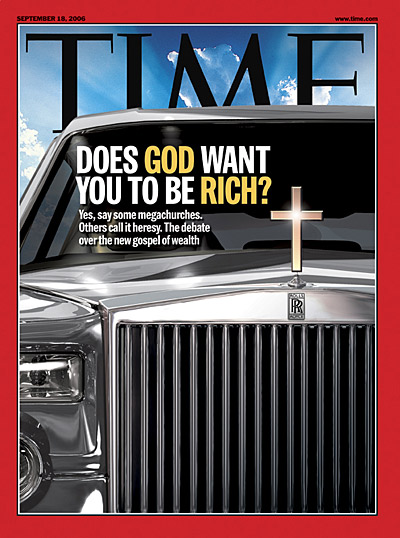
The current issue of Time magazine poses a provocative question as its cover story - "Does God Want You to Be Rich?"(Hat Tip: ThinkChristian). The article by David Van Biema and Jeff Chu is thoughtful, well written and balanced. It tackles the question by surveying the broad spectrum of answers coming from the Christian community. It has already provoked responses from various Christian leaders such as Al Mohler who has provided an insightful commentary.
I think this is interesting for a number of reasons. First, it's interesting that a mainstream publication like Time is devoting a cover to this issue. Evidently, they must see this as a key point of differentiation or segmentation within the church at large. Noting the varying views represented by different Christian leaders, one would have to conclude that Time is at least partially correct. Views range from those espoused by "prosperity gospel" proponents such as Joel Osteen to more cautionary, qualified answers from those in the traditional evangelical camp.
Second, I believe that our interaction with money on a daily basis makes this a vital question. Whether we're earning it, spending it, saving it, craving it or losing it altogether- we're interacting with money each and every day. Yet we spend so little time discussing this daily interaction from a biblical point of view. Some of the answers represented in the article indicate that more biblically centered discussion on this topic is sorely needed. So perhaps this question is a timely one (no pun intended, really!)
Finally, how an individual chooses to answer the Time magazine question really revolves around his/her understanding of the gospel and in particular, the intent of the gospel. While most Christians would agree that Jesus' death on the cross atoned for the sins of every believer, the ultimate purpose of this work is not always in view. This is how the apostle Peter understood this purpose in 1 Peter 3:18 -
"For Christ also suffered once for sins, the righteous for the unrighteous, that he might bring us to God" [emphasis mine]
The ultimate benefit we derive from the atoning work of Jesus Christ is a reconciled relationship with the living God. It's not enough just to acknowledge or even assent to the gospel. If we don't treasure or value that reconciled relationship, we will end up "loving" the gospel for all the wrong reasons. We may in fact acknowledge that Christ died for our sins but if we value other benefits like financial prosperity, health, etc... as equivalent or superior to the treasure of knowing God, we're worshiping the gift rather than the Giver.
The answer to whether God wants you to be rich, may well rest on whether you think the prize of our salvation is God Himself or simply a million dollar stock portfolio.
Subscribe to:
Posts (Atom)


